
Gutters and Ice Dams in Minneapolis: What Gutters Actually Do (and Don’t) in Winter
The relationship between gutters and ice dams is one of the most-confused topics in Minneapolis home maintenance. Some homeowners blame their gutters for every ice-dam leak; others remove their gutters entirely hoping to prevent winter problems. Neither approach is right. Gutters don’t cause ice dams — heat loss through the roof, combined with inadequate attic ventilation, does. But gutters absolutely participate in the ice-dam cycle, and the spec of the gutter system measurably affects how badly ice-dam conditions damage a Minneapolis home.
This guide is the honest 2026 Minneapolis-specific breakdown of gutters and ice dams: what gutters actually do in winter, what they don’t, and the specific gutter-system choices that help vs. hurt when ice-dam weather hits. For the full gutter system context, see the Minneapolis gutters pillar.
How ice dams actually form (and where gutters fit in the cycle)
Ice dam formation follows a specific sequence, and understanding it separates what gutters cause from what they don’t:
- Heat loss from the home warms the upper roof surface. Attic heat (from inadequate insulation, ductwork in the attic, can lights, bath fans, or air leakage from the living space) warms the roof deck enough to melt snow on the upper portions of the roof.
- Melt water flows down the roof toward the eaves. Under the snow blanket, melt water moves downslope.
- The eave and gutter area is colder than the upper roof because the overhang extends past the heated portion of the home and receives no attic heat. Sub-freezing air temperature outside, plus colder roof surface at the eave, equals re-freezing conditions.
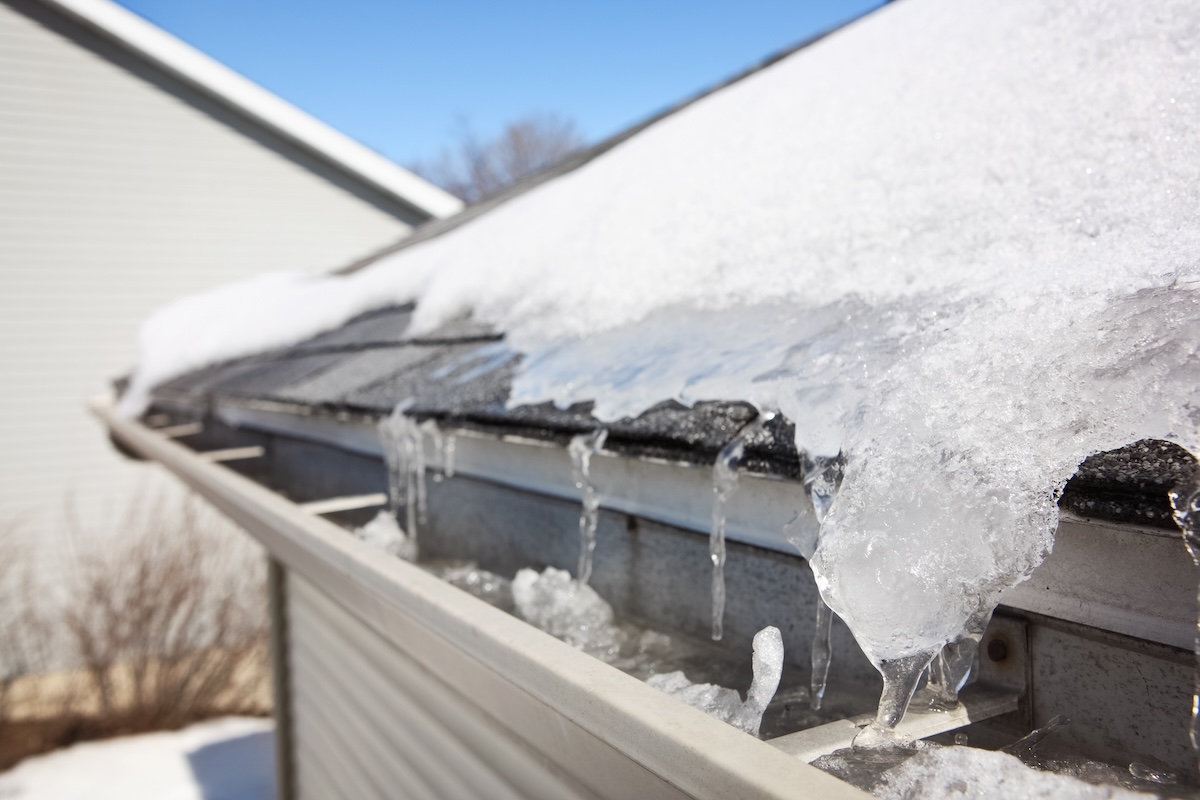
- Melt water hits the cold zone and refreezes, forming the ice dam. Ice accumulates at the eave, often extending up into and behind the gutter.
- Additional melt water backs up behind the dam and eventually forces its way under the shingles, running into the attic, walls, and ceilings.
Gutters don’t cause steps 1–3 — those are functions of the roof thermal envelope. Gutters are part of step 4: ice forms in and around the gutter as part of the dam, and the gutter’s design and condition affect how the ice behaves there. But removing the gutter doesn’t prevent steps 1–3; the dam just forms on the bare eave edge instead. For the broader roof repair winter context, see the Minneapolis roof repair pillar.
What gutters don’t do: the myths to let go of
Three persistent ice-dam myths about gutters:
- “Gutters cause ice dams.” No. Gutters are downstream of the cause. A home with perfect attic insulation, excellent ventilation, and tight air sealing won’t form ice dams even with gutters. A home with heat loss, poor ventilation, and air leakage will form ice dams with or without gutters. The causation runs from heat loss, not from gutters.
- “I should remove my gutters to prevent ice dams.” No, and this makes other problems worse. Removing gutters shifts the ice-dam discussion slightly — ice still forms at the eave, just without the gutter there to hold some of it — but it creates immediate summer foundation drainage problems and fascia-soaking from uncontrolled roof runoff. The tradeoff is unfavorable.
- “Heated gutter cables are the solution.” Partially. Heated cables melt narrow channels through ice that let water drain, reducing the most catastrophic backup events. They don’t prevent dam formation, they cost substantial electricity to run continuously in January–February, and they don’t address the root cause. Useful as a mitigating add-on on specific problem elevations; not a primary solution. See also cable heating detail at the gutter guards discussion.
The fundamental ice-dam fix in Minneapolis is always: upgrade attic insulation to R-49 or higher, ensure continuous soffit-to-ridge ventilation, air-seal all penetrations from the living space to the attic, and add ice-and-water shield at the eaves during the next roof replacement. See the Minneapolis roofing materials pillar for ice-and-water shield detail.
What gutters actually affect: Minneapolis winter performance specs
Where the gutter system genuinely matters in the ice-dam cycle:
- Hanger strength and spacing. Ice-laden gutters carry 10–15 pounds per cubic foot of ice. A 40-foot run fully choked with ice can weigh 300–500 pounds. Hidden hangers with structural screws spaced 18–24 inches on center hold up; spike-and-ferrule or widely-spaced hangers pull out and the gutter sags or detaches. For new installations on ice-prone elevations, specify 16-inch hanger spacing on north-facing and west-facing runs.
- Gutter profile and gauge. Heavier .032 aluminum resists bending under ice load better than builder-grade .027. Steel gutters flex less but weigh more. For repeatedly ice-damaged elevations, stepping up from .027 to .032 is cheap insurance. See gutter materials in Minneapolis.
- Cleanliness going into winter. A gutter full of leaves and debris freezes into a solid ice block much faster than an empty gutter. The leaves form an initial dam of their own, trap melt water that refreezes, and create the seed for the larger ice mass. Pre-winter cleaning is the single cheapest ice-dam mitigation a Minneapolis homeowner can do. See gutter cleaning in Minneapolis.
- Downspout capacity and placement. 3×4 downspouts with clear outlets move melt water out of the gutter faster, reducing the standing water that refreezes into ice. Well-placed downspouts on ice-prone elevations help; blocked or undersized downspouts accelerate the ice problem. See downspout sizing and placement.
- Gutter size. 6-inch gutters carry more capacity and handle melt flow better than 5-inch. They don’t prevent dam formation, but they delay the point at which water backs up and overflows. See 5-inch vs 6-inch gutters.
- Heat cable readiness. If heat cables are a planned mitigation, pre-install soffit outlets and route planning during gutter installation. Retrofit heat cable on an existing unprepped system is messier and less effective.
The Minnesota homeowners who have the fewest ice dam problems aren’t the ones with the most expensive gutters. They’re the ones who spent their mitigation budget on attic insulation, ventilation, air sealing, and ice-and-water shield underlayment during roof replacement, plus a good annual pre-winter gutter cleaning. The gutter system is a downstream participant in the ice-dam cycle, not the upstream cause. Spend accordingly.
— Summarized from a 2024 Minnesota Home Builders Association winter building envelope briefing
When ice damage has already happened: repair vs replace
Minneapolis gutters that have survived 15+ winters usually show at least some ice damage: bent sections, stretched hangers, pulled end caps, popped corner miters, or fascia rot behind the gutter. The decision tree for ice-damaged gutters:
- One or two localized issues on an otherwise-sound system. Repair. Rehang the sagging section with proper hardware, reseal the popped miter, replace the bent 10-foot section, and move on. See gutter repair in Minneapolis.
- Widespread ice damage across multiple runs and elevations. Evaluate the full system age. On a sub-15-year system, repair and address root causes (insulation, ventilation). On a 18+ year system, replacement is usually the better economic call.
- Fascia rot discovered behind damaged gutters. Replacement of fascia is already scope; adding new gutters during the same project is efficient. See fascia and soffit repair in Minneapolis.
- Interior water damage from an ice-dam event. The interior repair is separate from the gutter decision, but make sure the underlying ice-dam cause is addressed before spring. A new gutter won’t fix an ice dam; better attic insulation will.
- Insurance coverage. Minnesota homeowners policies typically cover sudden-event ice-dam damage (ceiling collapse, interior water damage). Gradual damage from chronic ice dams is generally excluded. See the Minneapolis storm damage claim pillar for insurance mechanics.
For the replacement timing signal, see when to replace gutters in Minneapolis; for full replacement context, gutter replacement in Minneapolis. Further reading: the University of Minnesota Extension ice dam guide, the IBHS winter roof resources, and the NRCA consumer resources.
Frequently Asked Questions
Do gutters cause ice dams in Minneapolis?
No. Ice dams are caused by heat loss through the roof (inadequate attic insulation, poor ventilation, air leakage) melting snow on the upper roof, which then refreezes at the colder eave. Gutters are part of the cold-eave zone where refreeze occurs but they’re not the cause. Removing gutters doesn’t prevent ice dams — ice still forms at the eave edge.
Should I remove my gutters in Minneapolis to prevent ice dams?
No. Removing gutters doesn’t prevent ice dams (they form at the eave with or without a gutter) and creates summer foundation drainage problems and fascia-soaking from uncontrolled roof runoff. The right ice-dam mitigation is upgrading attic insulation, improving ventilation, air-sealing, and adding ice-and-water shield during roof replacement.
Do heated gutter cables work in Minneapolis?
Partially. Heat cables melt narrow channels through ice that let water drain, reducing catastrophic backup events. They don’t prevent dam formation and cost substantial electricity to run through January–February. Useful as a targeted mitigation on specific problem elevations, not a primary solution. Address root causes (insulation, ventilation) first.
What gutter spec helps with ice dams in Minneapolis?
Hidden hangers on 16–18 inch spacing (vs. the default 24), .032 aluminum or heavier for bending resistance, 3×4 downspouts with clear discharge paths, and 6-inch gutter profiles on larger roofs. These specs help the gutter system survive ice loading without failing, though they don’t prevent ice dams themselves.
How do I fix ice-damaged gutters in Minneapolis?
For localized damage on a sound system, repair by rehanging or replacing affected sections. For widespread damage on an aging system, plan full replacement and address the underlying ice-dam cause (attic insulation, ventilation, air sealing) so the new gutters don’t face the same loading. Insurance may cover sudden ice-dam events but not gradual wear.
Looking for a Minneapolis contractor for ice-dam-resistant gutter spec?
We’re Minneapolis Roofing Company — a licensed, insured, local crew that handles gutter installation, repair, and replacement across the Minneapolis metro. If you’re looking for a Minneapolis contractor for ice-dam-resistant gutter spec, we’d love to be the name you recommend to your neighbor after the work is done.
